Why Buyers Keep Calling Wisconsin Metal Fabricators
The short answer
Wisconsin ranks first in the nation for employment concentration in fabricated metal products, and buyers have noticed. Private equity groups building one-stop metal suppliers, strategic acquirers adding capacity, and a wave of owner retirements have kept many well-run fabricators in the $5 million to $50 million revenue range on buyers' lists. What often separates the companies that draw multiple offers is a customer base spread across several end markets, a team that can run the shop without the owner, organized financials, and equipment that has been kept current.
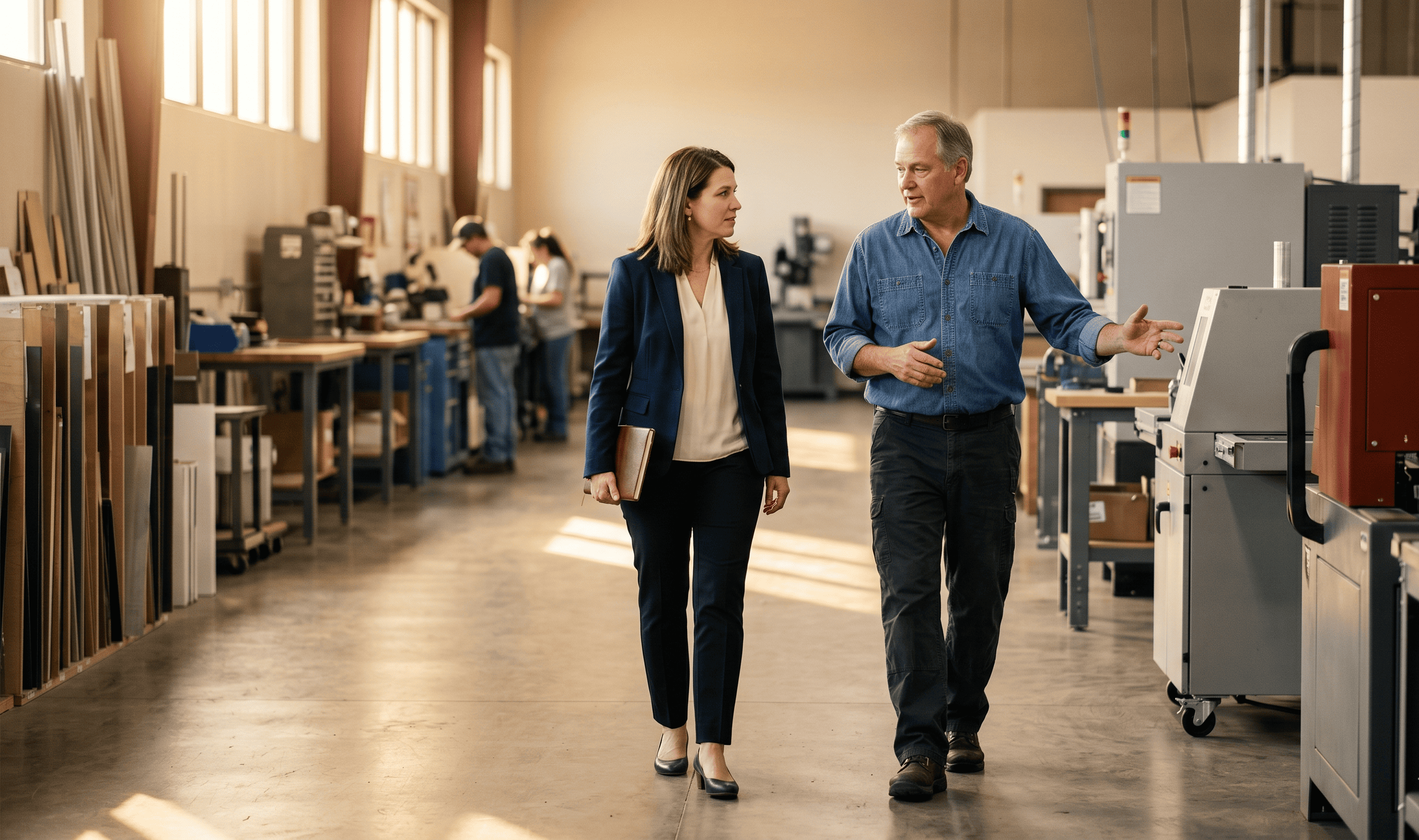
Drive the county roads from Sheboygan down to Kenosha and you'll pass them: steel buildings with a laser cutter running inside, press brakes lined up along one wall, and a lot full of pickups before sunrise. Metal fabrication is about as Wisconsin as it gets. Plenty of these companies started with one welder and a borrowed truck and grew into suppliers that OEMs across the Midwest depend on.
They also get a lot of phone calls. If you own a fabrication company in Wisconsin or elsewhere in the Midwest with a million dollars or more of EBITDA, someone may have already asked whether you'd sell. Here's what tends to drive that interest, what buyers often look for, and what you can do now.
Wisconsin builds metal parts like few other places
According to the Wisconsin Economic Development Corporation's 2026 Manufacturing Snapshot (based on Lightcast data), Wisconsin ranks first in the nation for employment concentration in fabricated metal products and first for manufacturing employment per capita. Manufacturing made up nearly 18% of the state's GDP in 2024, about 1.8 times the national average, and the state is home to more than 8,900 manufacturing companies.
That density often matters to buyers. A fabricator in Waukesha County or the Fox Valley sits inside a deep network of OEM customers, suppliers, and skilled trades that can be hard to replicate elsewhere.
What's driving buyer interest right now
A few forces tend to come up again and again.
Platform building. Private equity groups have spent years assembling one-stop metal suppliers by combining fabricators, stampers, and finishers. In recent years, for example, one private equity group built a regional metals platform by bringing together fabricators across Wisconsin, Illinois, and Minnesota. Once a platform is in place, it often looks for add-on acquisitions that bring new capabilities, customers, or geography.
Retirements. Owner age is a quieter driver. McKinsey's February 2026 report, The Great Ownership Transfer, found that more than half of U.S. small-business owners are over 55, up from roughly 30% in 2002. Many Wisconsin fabricators are led by owners who have been at it for decades, and the next generation doesn't always want the keys.
Strategic buyers adding capacity. Larger manufacturers often buy fabricators to add capabilities or reach new end markets, and electrical and power infrastructure has been one of several active areas. Over the past couple of years, established Wisconsin manufacturers have acquired fabricators in both Wisconsin and Northern Illinois to add capacity for electrical, energy, and other infrastructure customers. Demand in any single end market can shift with the economy or local policy, so buyers often prefer fabricators that don't depend on one.
What buyers tend to look for in a fabrication company
Every buyer has its own checklist, but a few things often separate the shops that draw competing offers from the ones that struggle to.
- Customer and end-market mix. One OEM at 40% of sales, or most of the shop's work tied to a single end market, can make buyers cautious. Work spread across ag equipment, construction equipment, food processing equipment, electrical, and other industries often reads as resilience, because a slowdown in one area is less likely to sink the business.
- People beyond the owner. The workforce picture is tight. In the Northeast Wisconsin Manufacturing Alliance's 2026 Manufacturing Vitality Index study (fall 2025 survey of 107 CEOs), 75% of manufacturers said they were concerned about finding the workforce they need, and machinists and welders/fabricators were named the hardest roles to fill. Buyers often look closely at whether a shop supervisor, an estimator, and a quality lead can run the floor without the owner.
- Equipment and capability. Fiber lasers, automated bending, robotic welding, and in-house finishing can make a difference. In the Wisconsin Center for Manufacturing & Productivity's 2025-2026 Wisconsin Manufacturing Report (survey of 405 executives, summer 2025), 47% said they were considering automation or new technology to address long-term workforce challenges. Buyers usually want to know which side of that line your shop is on and what capital spending is coming in the next few years.
- Organized financials. Buyers in this size range typically focus on adjusted EBITDA, and many will commission a Quality of Earnings review. Job costing that ties back to the financial statements and a clear record of add-backs often make diligence smoother.
Five things to do now, whatever your timeline
- Know your numbers the way a buyer will. Ask your CPA to walk you through adjusted EBITDA and gross margin by customer and by type of work.
- Build your second layer. Give a key employee real responsibility for estimating, scheduling, or customer relationships, and write down how the shop runs.
- Look at concentration honestly. If one customer or one end market is a large share of sales, even a gradual plan to diversify can help.
- Plan capital spending with a sale in mind. A buyer may value a recent laser or press brake, while deferred maintenance tends to show up in diligence and in the offer.
- Get your advisors talking. Your CPA, attorney, and wealth advisor each see a different piece of the picture. A middle market sale often takes roughly 6 to 12 months from engagement to closing, and sometimes longer, so coordinating your team a year or two ahead usually gives you more choices.
For the owner's advisors
- When a private equity firm or a larger fabricator calls a client out of the blue about buying the company, it's often the first sign buyers are interested. Before your client signs a confidentiality agreement (NDA) or shares any financials, it's a good moment to sit down with them and talk through what they, as the owner, want: whether to sell at all, and if so, when and on what terms.
- Watch for concentration. If a client's sales lean heavily on one OEM or one end market (data centers, a single equipment maker, one industry), expect buyers to ask about it, and it may show up in price or structure, such as an earnout. Diversifying well before a sale often gives the client more options.
- Owner age combined with no clear second-in-command is one of the clearest signals that succession planning should start.
- Equipment age and upcoming capital needs can affect both valuation and working capital discussions, so they're worth raising early.
Over the years, we've worked with a lot of Wisconsin manufacturing owners and the advisors who serve them. Most didn't start thinking about a sale until something forced the question: a health scare, a partner who wanted out, or a buyer who called at the right moment. The ones who planned ahead usually had more options. At Valens M&A, our job is to run a confidential, competitive process so an owner can compare real offers instead of reacting to the first one that shows up.
If you'd like to go deeper, these may help: Wisconsin Manufacturing M&A: What Owners Need to Know, Strategic Buyers vs. Financial Buyers, and Add-On Acquisitions: How Private Equity Creates Value Through Roll-Ups.
Advise or own a metal fabrication company in the Midwest and want to dive deeper into what buyers are paying attention to right now? We're always glad to have a confidential conversation.
This is general information, not tax, legal, or investment advice. Every business and every transaction is different. Clients should rely on their own CPA, attorney, and financial advisor for guidance on their situation.
About the author. Ed Krajcir is Managing Director of Valens M&A, where he leads confidential, competitive sale processes for privately held companies across the Midwest. Before Valens, Ed spent 20 years as managing partner of a business brokerage firm and worked on more than 200 main street and lower middle market transactions. Earlier, he ran divisions for a gas distribution contractor and a construction equipment manufacturer and led sales at a contract manufacturer. Ed works closely with the attorneys, CPAs, wealth advisors, and exit planners who advise business owners, because the best outcomes come from a coordinated team. He is a past president and current board member of Midwest Business Brokers & Intermediaries (MBBI) and holds a B.S. from the University of Wisconsin-Madison.
Sources
- Wisconsin Economic Development Corporation, Manufacturing Snapshot 2026 (Lightcast 2025 Q4 data)
- Wisconsin Center for Manufacturing & Productivity, 2025-2026 Wisconsin Manufacturing Report
- Insight on Business, NEWMA survey shows optimism for 2026 (December 17, 2025)
- McKinsey Institute for Economic Mobility, The Great Ownership Transfer (February 2026)